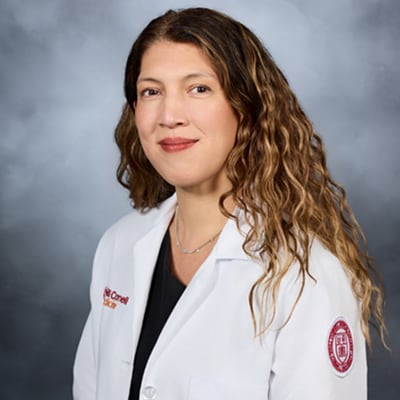
Through the Estée Lauder Emerging Leaders Fund, we champion organizations and individuals shaping the future of leadership. Meet Dr. Heather Yeo, an Associate Professor of Surgery at Weill Cornell Medicine and one of the leading voices in colorectal surgery and digital health innovation.
At the helm of Yeo Lab, she blends clinical expertise with forward thinking technology to improve patient recovery, strengthen the surgical workforce and address inequities in long term care. Her pioneering tools—from mobile health monitoring to data driven surgical solutions—are transforming how patients heal and how surgeons deliver care.
Below, Dr. Yeo shares how she’s reimagining patient support, why innovation and mentorship matters, and how the Estée Lauder Emerging Leaders Fund helps accelerate her mission.
Your research focuses on reducing gender and racial disparities in surgery. What do you see as the most pressing barriers for women pursuing careers in academic surgery today?
Despite real, measurable progress to decrease gender disparities in surgery, women remain evidently underrepresented in the senior ranks of academic surgery. Our lab’s work shows that, at current rates, parity among department chairs will take generations without intentional change.
The pathways to leadership are often opaque, with many unwritten rules about committee service, authorship and sponsorship. This can limit career advancement even when a candidate is outstanding. A clear system that values all aspects of labor, with continuity across organizations would allow surgeons to prepare and compete on a level playing field.
Women also face significant disparities in mentorship and sponsorship opportunities. Mentorship helps you grow and sponsorship opens doors. Women, particularly women of color, still receive fewer high leverage introductions, fewer first or senior authorship opportunities and fewer invitations to the rooms where decisions are made.
Our “Cutting Edge Women in Surgery” program, funded by Estee Lauder, directly targets these barriers through structured mentorship and sponsorship, qualitative research on women leaders, and a curriculum that makes the hidden curriculum visible, so that talented trainees can advance on purpose, not by chance.
How does increasing diversity among surgeon-scientists translate into better healthcare outcomes for women?
Diverse teams ask different questions, study overlooked problems and design solutions that reach more patients. When women and other underrepresented surgeon-scientists lead and collaborate, research agendas broaden, communication and trust improve, quality and safety rise and workplaces retain talent. Conditions that disproportionately affect women are more likely to be prioritized, with sex and gender aware study designs and meaningful subgroup analyses.
A workforce that reflects the communities it serves better understands lived experiences, which strengthens patient engagement, shared decision making and adherence. By investing in women surgeon-scientists, we accelerate discovery and deliver care that is better for patients.
As someone who has been successful in the medical field, what advice would you give to young women considering a career in surgery?
Start by finding someone who you connect with and treat the relationship as a two-way street. Your respect and hard work can benefit both of you. Do your best to follow up on new connections within 48 hours. It helps to send a brief paragraph research overview as well. Using this approach, you will build yourself a personal board of directors that you can explicitly approach for mentorship and sponsorship opportunities.
When you are negotiating and building your career, be sure to prioritize protected time and access to support staff, both research and administrative. Take your burnout prevention strategy seriously. Actions like setting protected blocks of time and saying no to tasks that do not advance your goals will have tangible benefits in making sure you can put your best work forward in whatever you pursue.
Finally, as your hard work pays off and your goals come to fruition, be sure to lift others behind you, paying forward the support and guidance you received in your early career. Mentoring amplifies your impact and builds durable professional networks while also contributing to promotion.
Mentorship seems central to Yeo Lab’s approach. What strategies have you found most effective in supporting women at different stages of their medical careers?
I like to tailor my mentorship strategy based on my mentee’s career stage. For premedical and medical students, I focus on system exposure and skill building: short, time boxed research projects; IRB ready protocols; and writing sprints that culminate in a poster or short communication. I learned long ago that early wins build confidence.
With residents, I teach them about leveraging their protected time and authorship pathways. We use a “project charter” that pre-specifies roles, authorship order, and deliverables, reducing conflict and ensuring credit.
Finally, I work with fellows and early career faculty on growing their visibility and network. We broker introductions to national collaborators, nominate women for panels and guideline groups, and rehearse “ask” conversations for protected time and promotions.
Can you provide a success story?
We have supported men and women from all backgrounds, races and nationalities and it is exciting because they are starting to become leaders themselves. I am particularly proud of supporting many of the individuals who started with me as medical students and are now attendings, mentoring others. Top of mind is a trainee who experienced a loss in the family during her training, and we were not sure she was going to continue. Through hands on mentorship and support, she went on to become a specialized surgeon with a growing academic career and family.
How do you envision partnerships with organizations like Estée Lauder helping to advance your mission?
Philanthropic partners accelerate and amplify impact by funding pilot and innovative work that traditional grants rarely cover. With support from partners like Estée Lauder, we are able to pursue studying the characteristics of successful women in academic surgery and translating those insights into a best practices curriculum. With this program, we can provide funded research opportunities and early career visibility to women trainees interested in surgery.
Philanthropy allows us to build systems that persist beyond a single grant cycle: leveraging the brand and network of Estée Lauder, we can disseminate our work more broadly and attract collaborators that are not normally available to academic surgeons. Together, we can shorten the timeline to equity from “someday” to this decade and, in doing so, deliver better surgical care for women everywhere.
Discover more about the Estée Lauder Emerging Leaders Fund.